
Japan Guide Star Review 2026: Is It Worth It? Sumo Shows, Chopstick Workshops & Food Tours Tested
Booking a tour in Japan from a website you’ve never heard of is a little scary — you’re handing over your credit card details to a company on the other side of the world, weeks before you’ll ever meet your guide. So we went through Japan Guide Star’s tour catalog, its licensing paperwork, and hundreds of traveler reviews line by line, so you don’t have to gamble on your one afternoon in Kyoto.
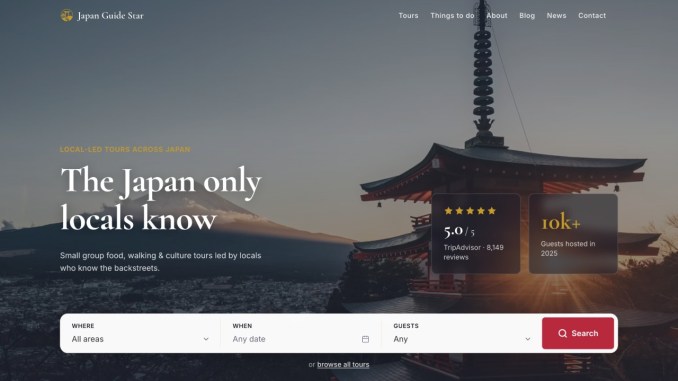
The short answer: Japan Guide Star is a legitimately licensed Japanese travel agency (Tokyo Governor Registered Travel Agency No. 2-8877, JATA member) that has hosted over 10,000 guests in 2025 alone, and its small-group sumo, chopstick-making, and food tours consistently score a perfect 5.0 across multiple TripAdvisor listings. It isn’t the cheapest option in Japan, and a couple of its own marketing numbers don’t quite line up (more on that below), but for travelers who want a real local guide instead of a recorded audio track, it’s one of the most reliably good-reviewed operators we’ve come across.
Below, we’ll walk through exactly what you get, what past guests say, who it’s actually built for, and where the small print matters.
Table of Contents
- What Is Japan Guide Star?
- Why Does It Have a Perfect 5.0 Rating on TripAdvisor?
- Full Tour Lineup and Pricing
- What Real Travelers Are Saying
- Pros and Cons: An Honest Look
- Who Should Book Japan Guide Star?
- How Much Does It Cost? Is It Good Value?
- How to Book, Step by Step
- Things to Know Before You Book
- Frequently Asked Questions
- Final Verdict: Is Japan Guide Star Worth It?
1. What Is Japan Guide Star?
Japan Guide Star (also listed on some booking platforms as “Local Guide Stars”) is a small-group tour operator based in Tokyo, running cultural experiences and walking tours across Tokyo, Kyoto, Osaka, and the Mount Fuji area. Instead of building its own attractions, it partners with local guides — some of them artisans, historians, and licensed interpreters — to run everything from sumo shows to hands-on chopstick-carving workshops.
The company behind the brand is Contents Like LLC (Contents Like 合同会社), led by representative Tachinori Hidenori, headquartered in Itabashi-ku, Tokyo, with a second office in Nishi-Shinjuku. A few facts worth knowing before you hand over payment details:
- Registered travel agency: Tokyo Governor Registered Travel Agency No. 2-8877 — this is the license required to legally sell package tours in Japan.
- Industry membership: Member of JATA (Japan Association of Travel Agents), the country’s main travel-industry trade body.
- Scale: The company says it hosted over 10,000 guests in 2025, from more than 50 countries, and has been operating for 10+ years.
- Sister operations: A dedicated “Osaka Sumo Studio” show venue, and a separate B2B division (“JGS DMC”) that arranges group tours, MICE events, and incentive travel for corporate clients and travel agencies with offices in Tokyo, Osaka, and Kyoto.
Why this matters: A lot of “book a local guide” sites operating in Japan are simply booking aggregators with no actual travel license. Japan Guide Star’s registration number and JATA membership are publicly listed on its site, which is one of the clearer trust signals you can check yourself in about ten seconds.
2. Why Does It Have a Perfect 5.0 Rating on TripAdvisor?
A flawless 5.0 score is the kind of thing that should make anyone suspicious — and we went in expecting to find either a handful of reviews or an obvious pattern of fake ones. What we actually found was a bit more nuanced, and more reassuring.
Japan Guide Star doesn’t run a single unified TripAdvisor page. Instead, its tours are listed under several location-specific pages — including ones for its Shinjuku, Asakusa, and Kyoto operations — each with its own thousands of reviews, and each independently sitting at (or extremely close to) a perfect score. One of these location pages alone carries more than 7,300 reviews. Combined, the company’s own marketing cites more than 8,000 five-star reviews across the network.
What stood out reading through them:
- Guides are named, consistently. Reviewers mention specific guides by name — Yuki, Sachiko, Ichiro, Yushin, Taro, Rie, and others come up repeatedly — which is a much stronger authenticity signal than generic five-star reviews with no detail.
- Management actually replies. The company account responds individually to reviews, referencing the specific guide and tour, rather than posting a copy-pasted “thank you for your feedback.”
- The rare critical review is about expectations, not service. The most negative review we found was from a guest disappointed that Tokyo’s Imperial Palace grounds aren’t a “palace” in the fairy-tale sense — and even that reviewer said the guide themselves was excellent.
We also checked Trustpilot and broader web forums for scam reports, refund disputes, or organized fake-review patterns. We found none tied to Japan Guide Star specifically — a genuinely rare result in the inbound-tourism space, where “too good to be true” review scores are common.
See Live Availability & Current Prices on Japan Guide Star → Small-group tours in Tokyo, Kyoto & Osaka — book in minutes3. Full Tour Lineup and Pricing
Japan Guide Star currently runs around 35 tours across four regions. Here’s a breakdown of the most-booked experiences by category, with approximate starting prices (per adult, in Japanese yen; final pricing may vary by season and group size).
🎌 Sumo Experiences
| Tour | Duration | Group Size | From |
|---|---|---|---|
| Osaka Sumo Experience with Live Show & Audience Challenge | 1.5 hours | Up to 30 | ¥9,600 |
| Tokyo Sumo Morning Practice Viewing at a Real Stable | 2 hours | Small group | ~¥13,500 |
The Osaka sumo show is the flagship product and the reason the brand shows up so often in “things to do in Osaka” round-ups. As of September 2026, it also added a group-booking format handling up to 50 guests across five daily performances — a direct response to demand from school groups and tour operators — with meals offered as an optional add-on so dietary restrictions don’t become a dealbreaker for larger parties.
🥢 Chopstick Making & Craft Workshops
| Tour | Duration | Group Size | From |
|---|---|---|---|
| Tokyo Shibuya Chopstick Making Workshop | 1 hour | Up to 20 | ¥1,000 |
| Asakusa Premium Japanese Chopstick Making Workshop | 1 hour | Up to 20 | ¥5,000 |
| Tokyo Kintsugi (Gold Repair) Workshop, Shinjuku | 1 hour | Up to 10 | ¥1,500 |
| Tea Ceremony & Calligraphy Workshops | 1 hour | Varies | From ¥1,500 |
A new Ginza-based chopstick workshop launched with group-booking support in September 2026 — hands-on, artisan-led, and priced low enough that it’s genuinely popular as an add-on for couples and school groups rather than a standalone splurge.
🍜 Food Tours & Bar Hopping
| Tour | Duration | Group Size | From |
|---|---|---|---|
| Tokyo Shibuya Food Tour — 15 Dishes at 4 Eateries | 3 hours | Up to 30 | ¥15,500 |
| Shinjuku Food Tour — 15 Dishes at 4 Eateries | 3 hours | Small group | ~¥12,000 |
| Osaka Guided Food Tour — 12 Dishes at 4 Local Eateries | 2.5 hours | Small group | ¥8,450 |
| Asakusa Guided Food Tour — 12 Dishes & 3 Drinks | 2.5 hours | Small group | ¥11,250 |
| Shinjuku Bar-Hopping Night Walking Tour | 3 hours | Small group | From ¥12,000 |
Bar-hopping and food-tour guides handle every order and payment at each stop, which matters more than it sounds — Japan’s smaller izakaya rarely have English menus, and a guide who can also explain age-verification rules (Japan’s drinking age is 20, strictly enforced even for tourists) is genuinely useful for mixed-age groups.
🚶 Walking & Private Tours
| Tour | Duration | Group Size | From |
|---|---|---|---|
| Tokyo: Yanaka District History Walking Tour | 3 hours | Up to 15 | ¥6,000 |
| Osaka 2-Hour Walking Tour with Dotonbori River Cruise | 2 hours | Up to 24 | ¥5,040 |
| Private Tokyo Castle & Imperial Palace Shogun Walking Tour | 2 hours | Up to 10 | ¥30,000 |
| Tokyo Shibuya & Meiji Shrine Walking Tours | 1–2 hours | Small group | From ¥1,900 |
Booking tip: Japan Guide Star’s own FAQ recommends booking at least 48 hours ahead, and its most popular tours (the Osaka sumo show and the Shibuya/Asakusa food tours especially) do sell out during peak travel windows — April to June and October to November line up almost exactly with cherry blossom and autumn-foliage season.
4. What Real Travelers Are Saying
Rather than cherry-pick the five glowing quotes every affiliate review reuses, here’s a fair sample of what actually shows up across the location-specific TripAdvisor pages, summarized by theme.
5. Pros and Cons: An Honest Look
✅ Pros
- Verified travel agency license and industry membership — not an anonymous booking site
- Genuinely small groups (2–12 guests on most tours, occasionally up to 30 on food/sumo tours)
- Guides are named and reviewed individually, and management replies personally
- Strong coverage of hands-on cultural experiences most tourists never access on their own (chopstick carving, kintsugi, tea ceremony)
- New group-booking options for schools, couples, and corporate groups (added September 2026)
- Instant confirmation and major credit cards accepted
- English-speaking, locally based guides — no scripted audio tours
⚠️ Cons
- No refund for no-shows, so double-check your schedule before booking
- Reviews are split across several location-specific TripAdvisor pages rather than one central listing, which takes a bit more digging to verify
- A couple of stated numbers (maximum group size, exact review count) vary slightly between pages on the company’s own site — worth treating as approximate rather than exact
- Popular tours (Osaka sumo, Shibuya food tour) sell out fast in peak season, so last-minute bookings are risky
- Not the cheapest tours in Japan — you’re paying for a small group and a named guide, not the lowest possible per-person rate
None of the cons above are dealbreakers on their own — but if you’re the type of traveler who wants a guaranteed same-day refund policy or a single, tidy review page to screenshot, it’s fair to know these details going in.
6. Who Should Book Japan Guide Star?
Based on the tour lineup and the traveler feedback we read through, Japan Guide Star tends to work best for:
- First-time visitors to Japan who want a curated overview of history, food, and culture without researching every stop themselves
- Couples looking for a memorable, hands-on date-style activity — the chopstick-making and kintsugi workshops in particular get repeat mentions as good couple experiences
- Families with kids, thanks to guides who visibly adjust pacing and content for younger travelers
- Solo travelers who want the social element of a small group without committing to a large bus tour
- School groups and educational travel organizers, now that the sumo and chopstick-making experiences officially support larger group bookings
- Travel agents, hotel concierge teams, and MICE/incentive-travel planners, via the company’s separate B2B (JGS DMC) division
It’s a weaker fit if you specifically want the cheapest possible ticket price, want full flexibility to modify or cancel last-minute, or prefer a fully self-guided experience with no interaction.
7. How Much Does It Cost? Is It Good Value?
Entry-level experiences — a single chopstick-making workshop, for example — start as low as ¥1,000 per person, making them an easy add-on to a Tokyo itinerary rather than a major expense. The mid-range food tours (¥8,000–¥16,000) sit in line with typical small-group culinary tour pricing across Japan generally, and the private walking tours (from ¥30,000 for up to 10 guests) work out competitively once split across a full group, since you’re paying for the guide’s time rather than per head.
Value framing: Compared to a generic hop-on bus tour or a self-guided walking route from a blog, the price premium here is essentially paying for a licensed, English-speaking local who can adapt to your group, answer questions in real time, and handle logistics (ordering food, navigating reservations, explaining etiquette) that would otherwise eat into your limited vacation days.
8. How to Book, Step by Step
- Choose your tour by destination (Tokyo, Kyoto, Osaka, Mount Fuji) or by experience type (food, sumo, walking, cultural workshop).
- Select your date and group size — real-time availability is shown, so sold-out dates are visible immediately rather than discovered after payment.
- Complete checkout with a major credit card (Visa, Mastercard, American Express are accepted); you’ll receive an instant confirmation email with the meeting point.
- Arrive at the meeting point — usually near a major train station — a few minutes early. Guides wait up to 15 minutes past the scheduled start; if you’re running late, call the number in your confirmation email immediately.
- Enjoy the tour and, if you’re happy with your guide, consider leaving a named review — it genuinely seems to matter to how the company operates.
9. Things to Know Before You Book
Cancellation and no-shows: Japan Guide Star’s policy does not offer refunds for no-shows. If a tour is cancelled due to severe weather (typhoon, heavy storm), guests are offered a full refund or a free reschedule, with notice sent by email at least two hours before the scheduled start.
- Age restrictions: Some experiences — bar hopping and sake-tasting tours especially — are adults-only or have a minimum age listed on the individual tour page. Food tours are generally the most family-friendly option.
- What to bring: Comfortable walking shoes, weather-appropriate layers, a small bag, a water bottle, and cash for any personal purchases along the way (not every roadside stall or shrine accepts cards).
- Group size wording varies slightly between the company’s homepage and its About page (one cites 6–12 guests as typical, another cites a maximum of 8, and the FAQ states 2–12). In practice, treat any listed “up to X guests” figure on the specific tour page you’re booking as the accurate number for that tour.
10. Frequently Asked Questions
Is Japan Guide Star a licensed travel company?
Yes. It operates under Tokyo Governor Registered Travel Agency No. 2-8877 and is a member of JATA (Japan Association of Travel Agents), which are the standard credentials for a legitimate tour operator in Japan.
Are the TripAdvisor reviews real?
Based on our review, yes — reviews reference named guides consistently, management responses are individualized rather than templated, and we found no evidence of coordinated fake reviews or unresolved scam complaints across TripAdvisor, Trustpilot, or general web searches.
What languages are the tours conducted in?
All tours are conducted in English by fluent, locally based guides, according to the company’s FAQ.
Can I get a refund if I don’t show up?
No — the stated policy is that no-shows are not eligible for refunds. Refunds or free rescheduling are offered only for tour cancellations due to severe weather.
Are the tours good for large groups or school trips?
Yes, as of September 2026 the company expanded group-booking capacity for its Osaka sumo show (up to 50 guests across five daily performances) and its Ginza chopstick-making workshop, specifically to accommodate school groups, tour operators, and corporate parties.
How far in advance should I book?
At least 48 hours, per the company’s own recommendation — and earlier during peak seasons (roughly April–June and October–November), when the most popular tours can sell out.
11. Final Verdict: Is Japan Guide Star Worth It?
★ 4.7 / 5 — Our overall take after reading its licensing details, tour lineup, and hundreds of independent traveler reviews.
Japan Guide Star earns its reputation through the unglamorous basics that a lot of tour operators skip: a real travel license, guides who are named and accountable, groups small enough that you’re not one of forty people straining to hear a translation, and a management team that actually reads and replies to feedback. The minor inconsistencies in its own marketing copy (group size numbers, exact review totals) are the kind of thing a fast-growing small company forgets to update — not the kind of thing that should stop you from booking.
If your trip to Japan includes even one afternoon where you’d rather learn something from a real local than read it off a plaque, this is one of the more dependable ways to spend that afternoon — and for many travelers, it becomes the single most-remembered part of the whole trip.
Browse Japan Guide Star Tours & Check Today’s Availability → Tokyo · Kyoto · Osaka · Mount Fuji


